Page 10 of 14

Zbrush to A:M

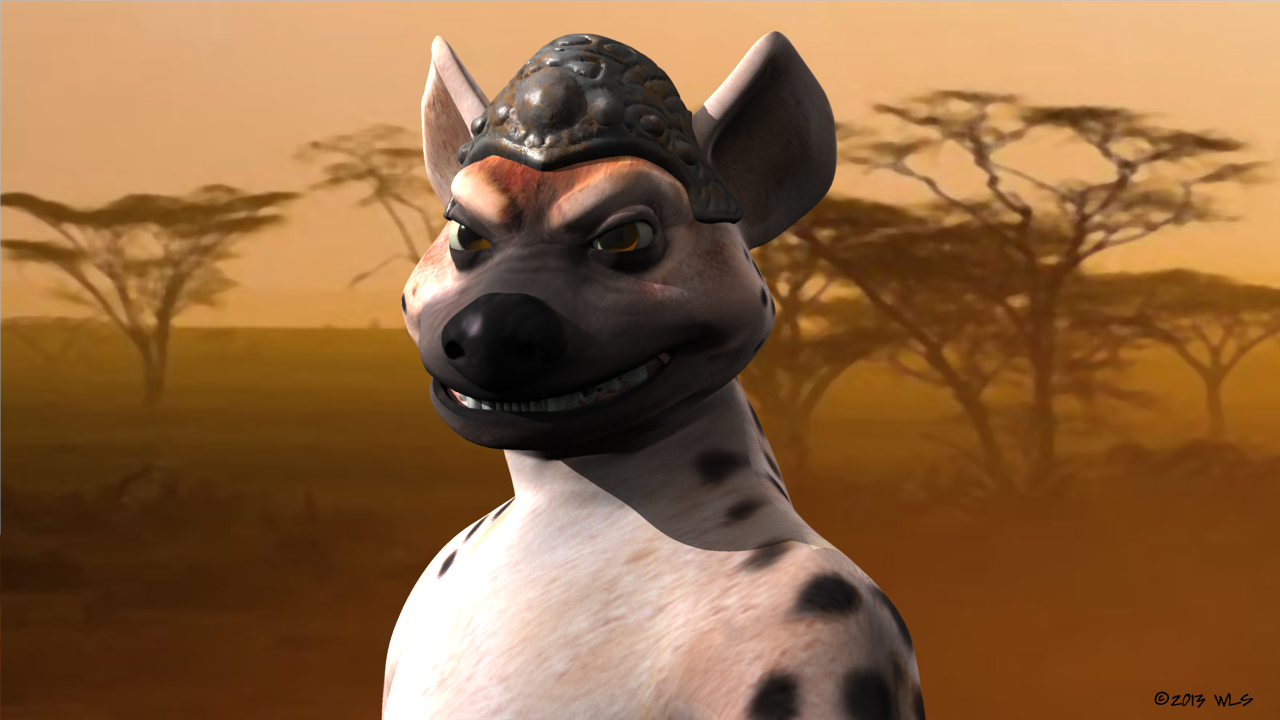
I had an idea this evening to see whether I could combine Zbrush and Animation:Master by using the extract command in Zbrush to create equipment (in this case a helmet) and bring that geometry back into A:M as a PROP.

So I exported the Hyena as an .obj and imported it into Zbrush, painted a mask for the helmet and extracted the geometry. I then sculpted some detail–though  not too much, because I wasn’t sure it would work…

helmet

Before exporting the helmet, I ran the Decimation command on it to reduce the polygon count, then exported an .obj file. In A:M I imported the helmet and assigned a rusty steel DarkTree material to it. I dragged and dropped it into an Action and it perfectly aligned with the Hyena model! All I had to do was add a translate to and orient like constraint to the head controller and I was done:

hyena-helmet

I’m not sure if I will use this technique on some of the gear, or if I would just model from scratch in A:M. I just wanted to try it and see what happened. A:M has a reputation for not playing well with polygon-based programs, but I think you just have to understand the limits and work around them. For landscapes or hard-surface objects that don’t need to deform, use the PROP feature and you shouldn’t have any problem.

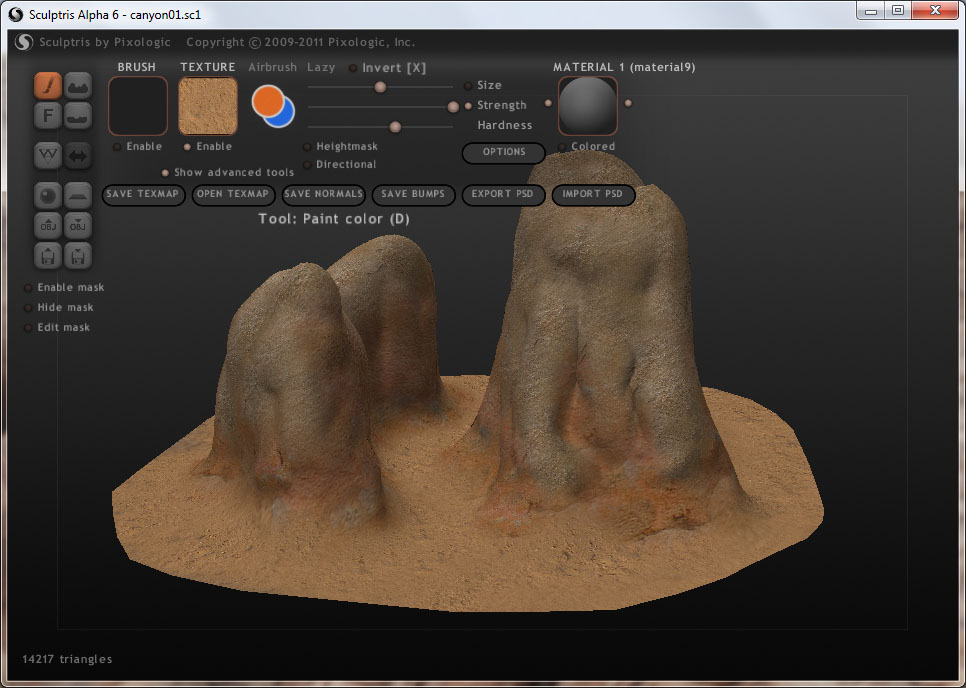
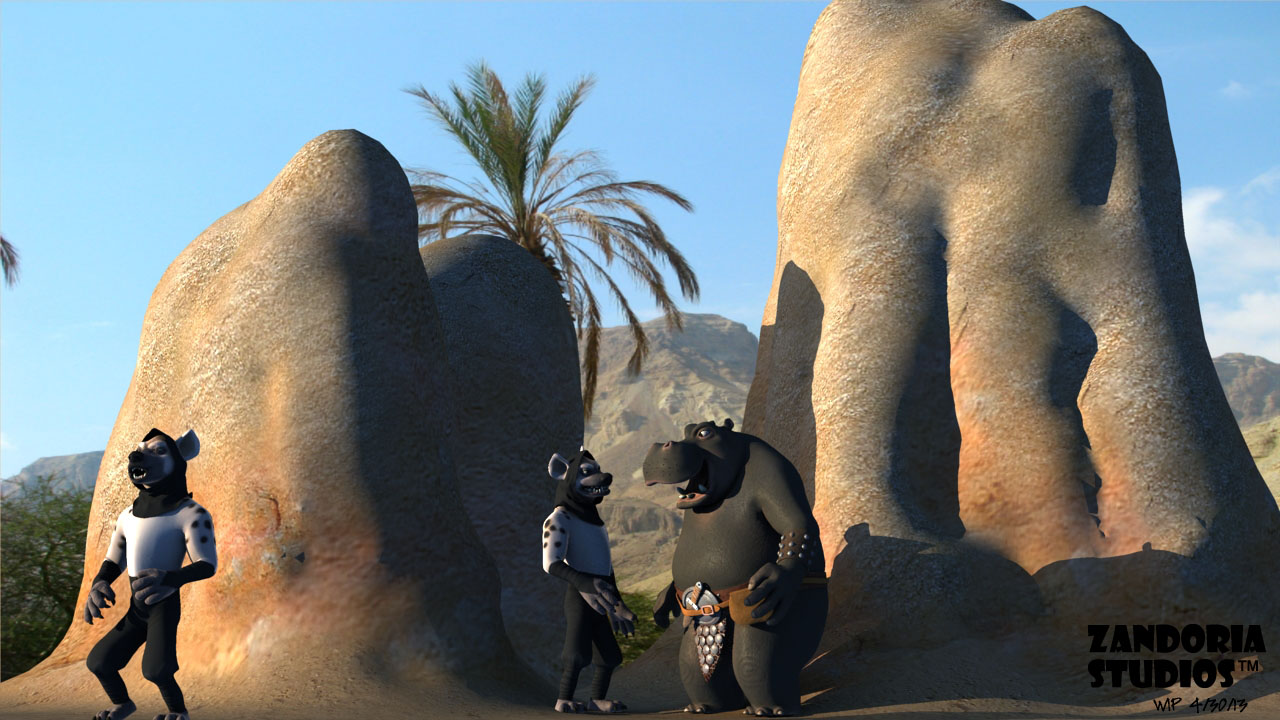
I recently experimented with modeling a simple landscape object in Sculptris, and it also worked great in A:M

sculptris_screencap

tar+hyena2.0

Kickstarter Results


So looking at the underwhelming Kickstarter results, I was pretty discouraged for a couple of days… I had a goal of $10,000 for producing the first episode of this series, but only got $1,587 in pledges over the 30 day campaign.

I had thought that I would get a lot of help from the Animation:Master community in spreading the word about the project, so I was suprised that I only had a few friends share the link. The same was true on Facebook (which actually hurt my feelings)! I can understand not having the money to pledge–but I expected that my friends would at least help me get the word out.

So to those 48 backers who DID pledge, I am extremely grateful. And to those friends who DID spread the word, thank you!

It is a humbling experience for an artist to put there work out there and discover how small their fanbase really is. I have learned that my “network” is pretty small–and I have to work on putting stuff out here that is for those true fans, and hope that “my people” find their way here. Without true fans, there is no way a crowdfunding campaign is going to get the attention to succeed.

I found that blogs like Cartoon Brew and Animation Scoop are not interested in covering a project like this–though they would be happy to sell me a banner ad on their blog for $300/week…. CGTalk will not even let you make a POST on their forum about your campaign, even though they would like to think that they are helping artists develop their own IP.  The A:M Community boasts 10,442 members–however there were only 10 pledges that came from the hash.com domain…. One pledge came from Twitter.

So I have to rethink where I have been posting my work. I have a WIP section on the Hash forum where I’ve been posting my stuff, but I think that I should have been posting here instead.

Digital Watercolor

Chick_color


chicks05

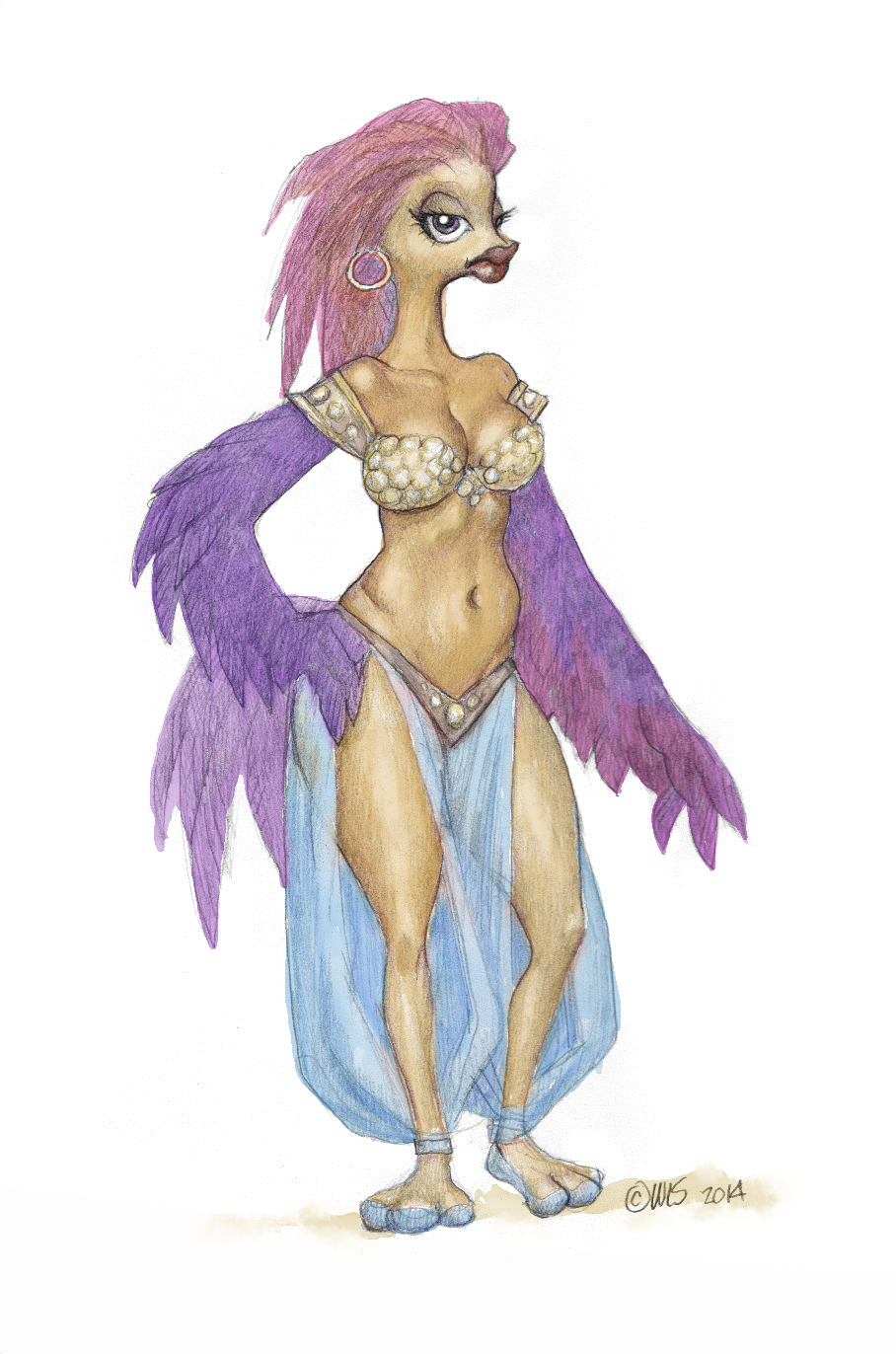
Experimenting with some digital watercolors over top of a scanned sketch. Done in ArtRage4. This is one of the dancing girls at the Waterhole.

TAR of Zandoria Kickstarter is LIVE!

My Kickstarter campaign is LIVE! Please check it out–and pledge your support! For only $1 you will have my gratitude and I will list you in the credits as a supporter.
Please pass it on and help me spread the word! The key to the success of this effort is letting people know about it!

I’m raising money to produce the first episode of this series. Please help bring TAR of Zandoria to life!

Forever Alone Filmmaking Podcast

M Dot Strange recently interviewed me for the Forever Alone Filmmaking Podcast. It is a show made by and for 3D animators who are making their own original films. We talked about how I got into animation, the TAR of Zandoria project, Animation:Master and other stuff….

Hope you enjoy! Leave a comment below, if there is anything that came up that you would like to talk more about.

Modeling the Ninja Hyena

hyena with furImage

I’m still plugging away… Not as much progress as I would like on this project, and it feels like I am years away from where I would like to be.

I’ve finished the model and am into the rigging and CP weighting now. I was discussing the future of A:M with some fellows on the Hash forum–It doesn’t seem like there are as many projects going on as in the old days…. At times I feel like there are only a handful of artists and studios using this software, so I thought I should post an update.

[edit 2/12/13] I’ve been working on the textures and fur. Still some tweaking to do… Using the Muhair shader

I was watching the credits on Brave and recognized a couple of Animation:Master alumni on the Pixar crew (Pixar has a proprietary software, not A:M)–Barry Zundel was one of them. Barry has been writing a series about software usability on his blog, and had this to say about A:M which he used while working at Avalanche Software :

…In the ensuing years, I used A:M exclusively and came to understand what “usability” really is. It is still one of the best examples of a truly non-linear pipeline ever. Nothing that I have tried has ever come close.

I have to wholeheartedly agree with Barry on Animation:Master’s usability! Barry also has a series of A:M tutorials available on his website that I highly recommend.

Bring Your Dreams to Life!

Bring Your Dreams to Life!

I was reading a story in the LA Times about low-budget animated movies. The writer says:

Last year’s “Puss in Boots”was made on the lush 13-acre DreamWorks Animation campus in Glendale by 300 people working for four years at a cost of $130 million.

Its knockoff was made on the second floor of an office building just two miles away— by 12 people, in six months, for less than $1 million.

The tone of the article isn’t what got my attention, instead it was the difference in approach between the two types of studios, and the radical difference in thinking… I think that there is a mentality that it can’t be done except the Dreamworks/Pixar/Sony/BlueSky way: lots of people and lots of time.

One of the objectives of The Tin Woodman of Oz project was to road-test the production capabilities of A:M–and it did! I already knew that it could–I used it to create CG animation for Brian Michael Stoller’s “Miss Cast Away” a few years before. There is no reason that producers wanting to try to cash in on the animation craze shouldn’t be looking at Animation:Master and its community of animators.

I’ve been working with A:M since 1999, and I can take a character sketch and turn it into a ready-to-animate model. Or I can start with just your idea or script and help you to produce it. I’m available as a consultant if you need help setting up a studio, or with training.

For an independent animator, or a small studio, or if you are a producer looking to create an animated film, I can help you bring your dream to life.

Resolution Independence

20120616-171729.jpg

If you are familiar with Adobe Illustrator and Photoshop, you know that vector artwork is scalable to any size, from business card to billboard, and it will look good. A raster or pixel-based image will not look good if you try to print or display it larger than it was created for.

Similarly, most 3D models are created with a level of detail appropriate for the intended output; different models for animating, higher resolution for rendering, even higher (billions of polygons) for 3D printing…

Animation:Master’s splines are very similar to Illustrator’s curves. You can create a very detailed model without a lot of polygons (actually A:M doesn’t use polygons at all). The splines connect to form a network called “patches”. Because the model is light, there is usually no need to use a proxy model when animating.

Because the geometry is spline-based, you can view it at any scale and it still looks good. It is resolution independent, so you can render it at any size. Technology continues to evolve, and what is considered high-definition today may seem low-res in a few years. However, the models that you create in Animation:Master today will still be good no matter what future display requirements might be.

20120616-210319.jpg