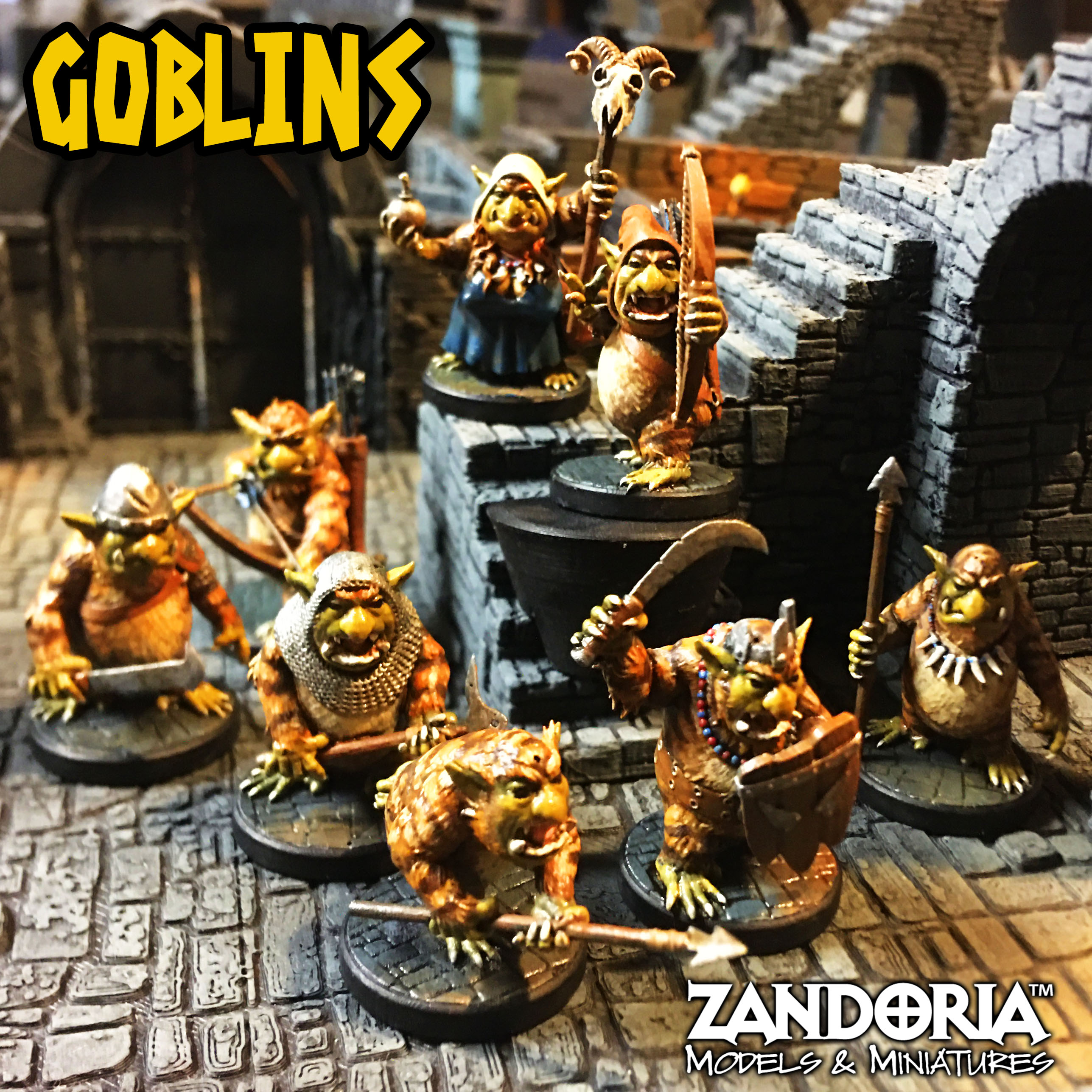
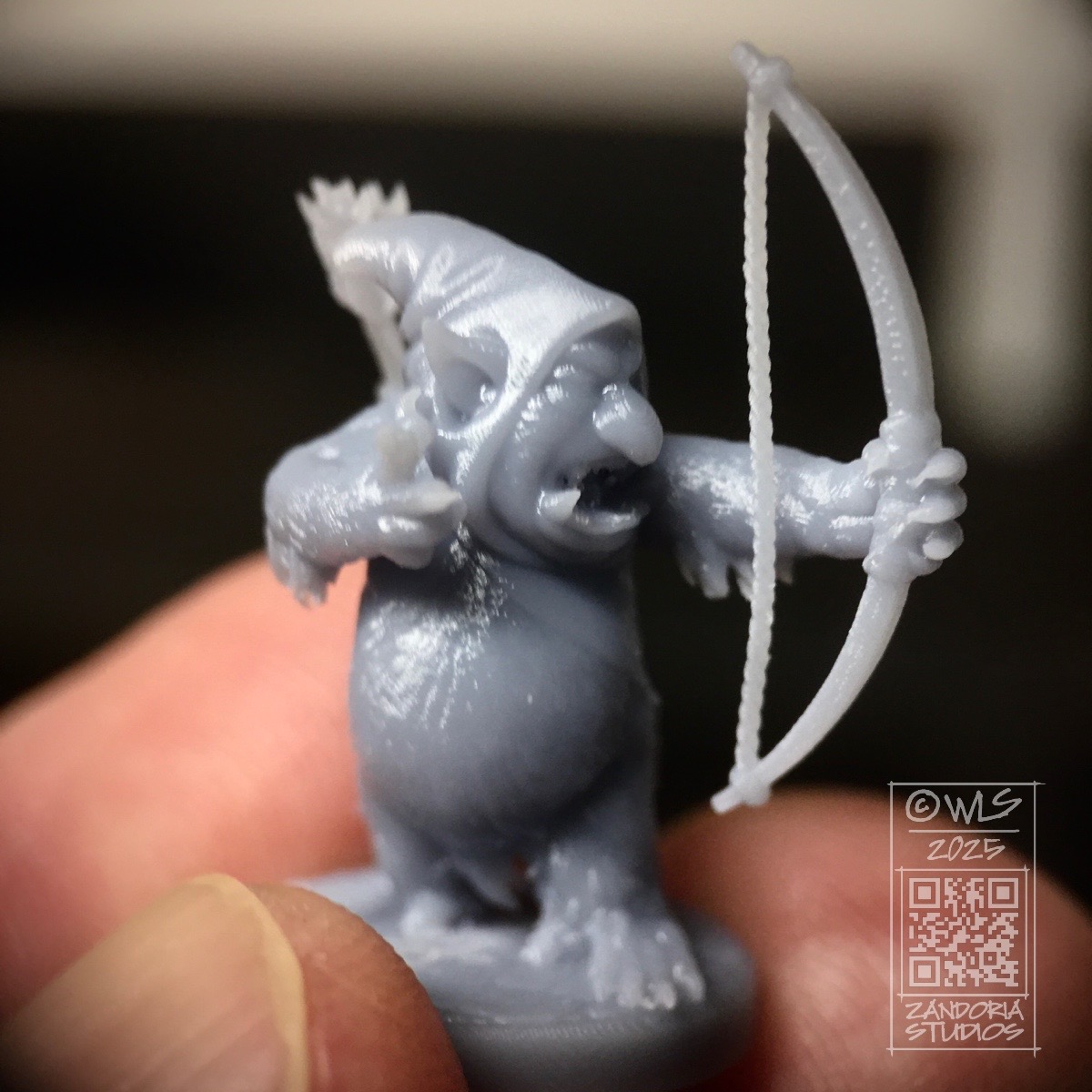
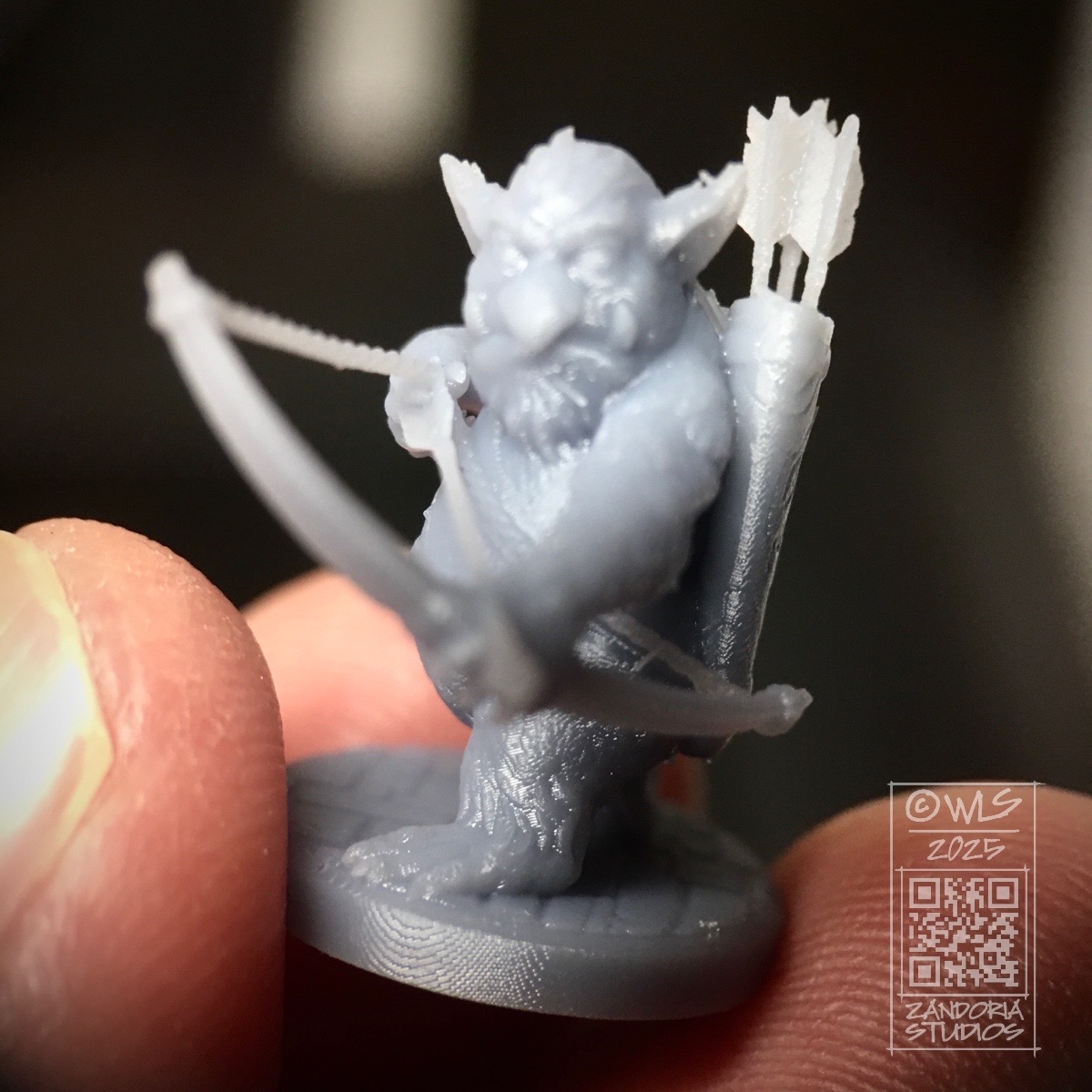
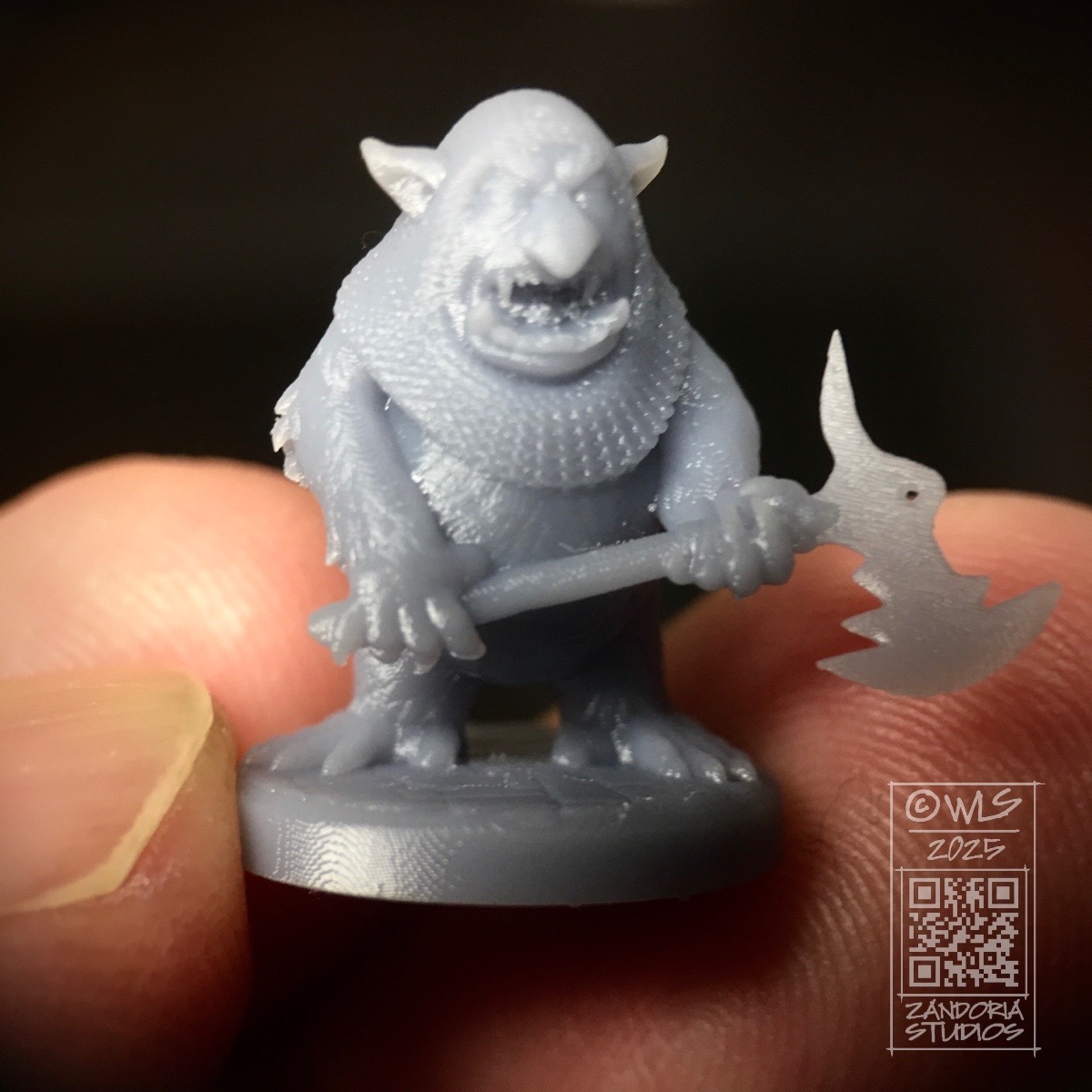
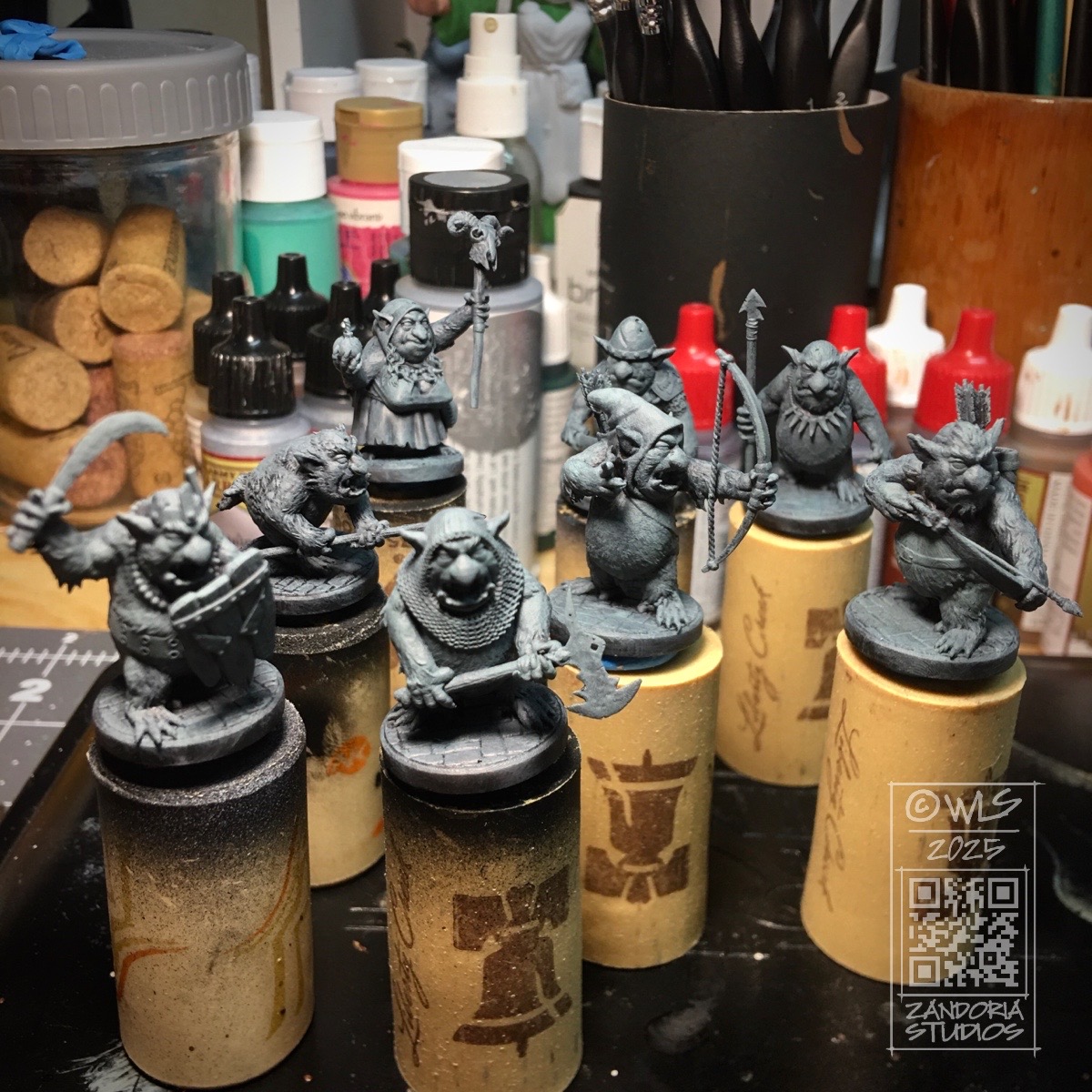
This is a set of 3Dprintable goblins that I just finished. They are bestial and vicious, covered in fur, with large teeth and claws. Their weapons and armor are scavenged scraps that they have collected from raiding,
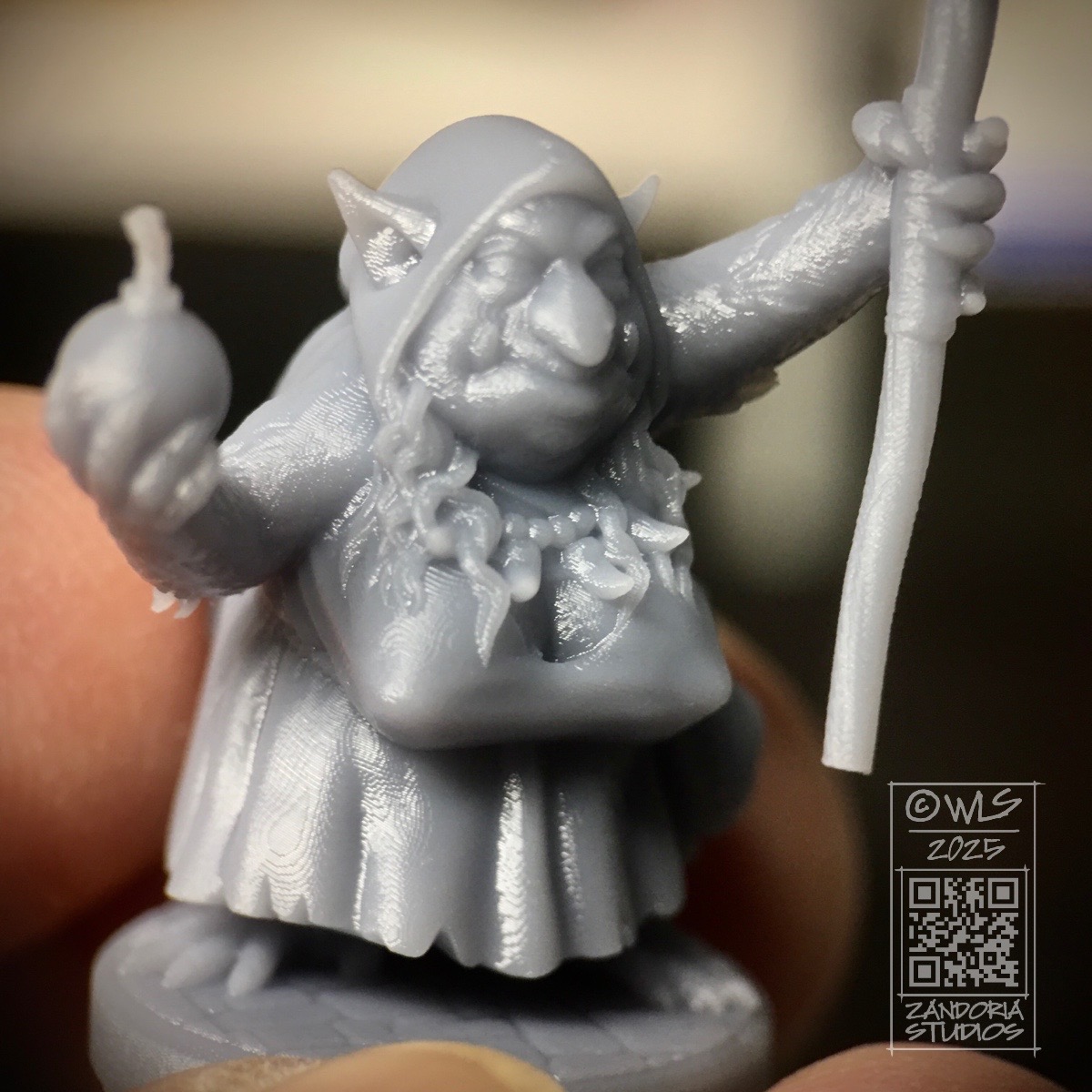
Goblins combined foul and stinky substances from their caves–batshit, sulpher, ashes–accidentally discovered a crude gunpowder, and invented the goblin bomb! This goblin mother is the leader of her pack. She has a bomb in one claw, and a magic staff topped with a goat skull in the other.
There are 8 different goblins in this set. I have them available in resin on my shop, or you can also buy the files to print them yourself.
Playing D&D is great fun, and I have been adventuring with my friends for many years. We have always played the game around the table with just our character sheet, notes and dice. The DM might have a hand drawn map, but for the most part all encounters are just described in what is called the Theater-of-the-Mind style of play.
TotM can lead to confusion. “Wait, how many goblins are left?”, or “I said I was hiding behind the pillar!”, or the classic: “I didn’t ask you how big the room is–I cast Fireball!” Many of the rules in D&D are very tactical in nature. Players are aware how many feet they can move per turn, their weapon ranges, what the bonuses are for 1/2 or 3/4 cover, and are constantly peppering the DM with questions to clarify the described situation. Miniatures solve many of these issues.
With terrain and miniatures, it is very easy to see who is in the area of effect when the Fireball spell goes off. Miniatures provide clarity vs. chaos, save time and avoid unnecessary arguments.
Theater-of-the-mind may be great for most D&D encounters, and some players think that playing with minis will make the game feel too much like a boardgame. This is a valid. If the Dungeon Master gives a great description of the boss encounter, it can really come to life in the players imagination. However, what gets imagined is going to be slightly different for each player….
This party of gnome adventures is exploring the room, when behind them they hear the scrape of stone on stone…
The Dungeon Master says, “You turn and see a large mountain troll, with a stone axe”. As a player you may wonder what a mountain troll looks like, or how big it is relative to you; whether you should start running or draw your sword.
The DM says, “roll initiative” ominously, as he places the mountain troll mini onto the table. The players eyes go wide. They see it’s size. The immediate, visceral understanding of the threat is an “oh $#!%” moment.
Don’t just describe the threat. Make them feel it…
The moment you place that troll on the table, the game’s tension skyrockets. It is no longer an abstract concept; it’s a physical problem they need to solve. Miniatures are not mere game pieces, but are tools for creating sharper, more dramatic, and more memorable stories at your table.
These are all miniatures and terrain that I have sculpted, and are available in my shop
Maybe you are a “Theater of the Mind” player that has avoided using minis and terrain… Sometimes there just isn’t room on the table for terrain. I see very impressive 8′ long tables with thousands of dollars worth of Dwarven Forge tiles, and while it looks awesome, it just isn’t going to work for a group of players at the kitchen table.
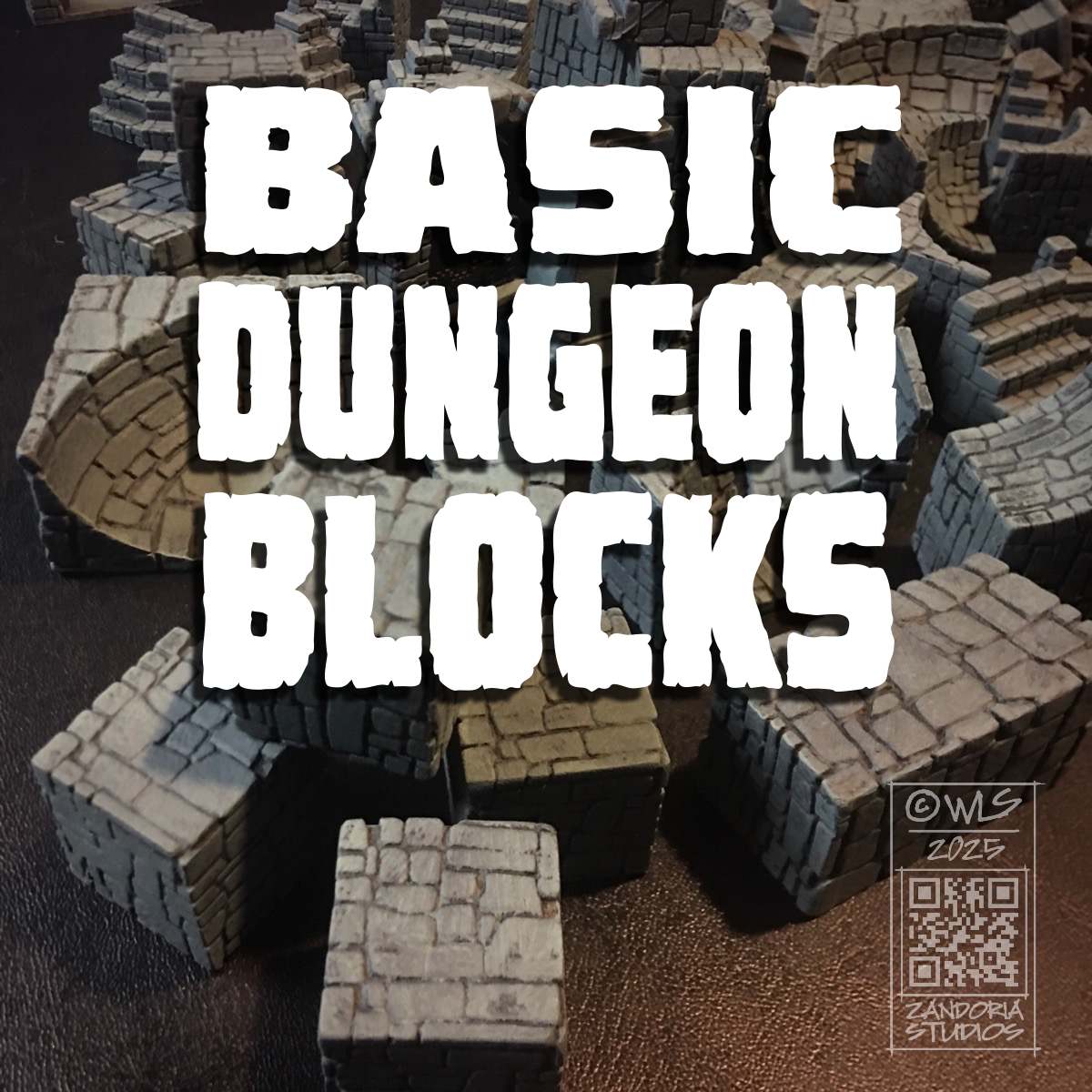
While a dry-erase mat is a good compromise, it lacks the appeal of seeing your carefully painted minis in their natural setting–the Dungeon. I felt there was a need for something small and simple, that would allow the DM to quickly layout the map for a combat encounter or boss battle. That led me to creating these Basic Dungeon Blocks. You arrange them and stack them just like children’s toy blocks!
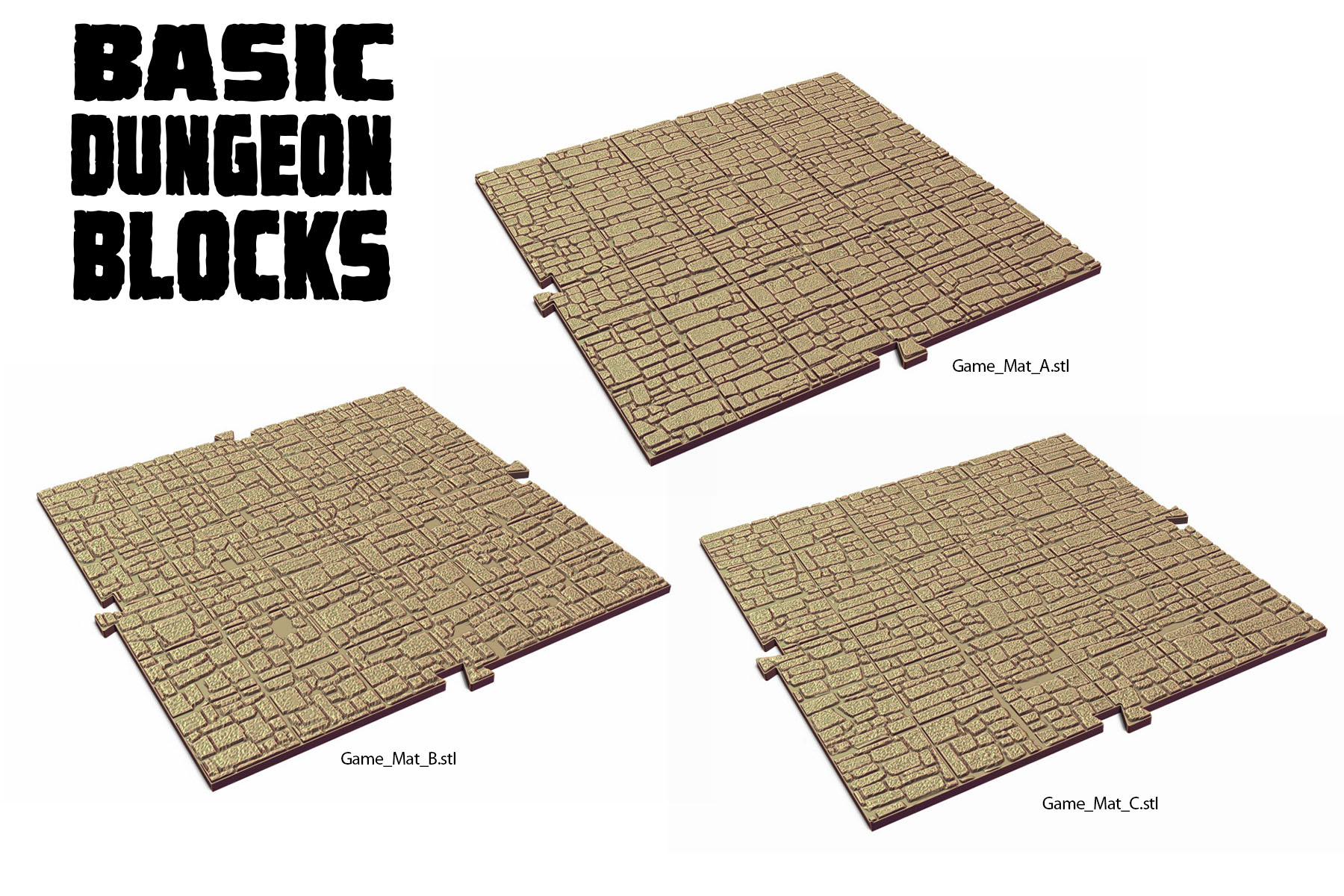
They are simple building blocks based on a 1″ cube. There is also a game mat made from 6″ tiles, so that you have a gridded surface to build and play on.
Using these building blocks, you can quickly layout the dimensions of the room or corridor. How many times have you had a player insist that they weren’t in the room when you asked their character to roll a saving throw? Having some terrain and minis avoids confusion and allows the DM to be clear with the obstacles that the characters are facing.
There are a variety of Blocks, stairs, arches, doorways (with working doors), pillars. Even curved blocks for building a sewer–Or a Dwarven Skatepark! And because they are based on 1″ cubes, they can also be used with ANY other terrain system (such as PuzzleLock Dungeon II) to customize an area.
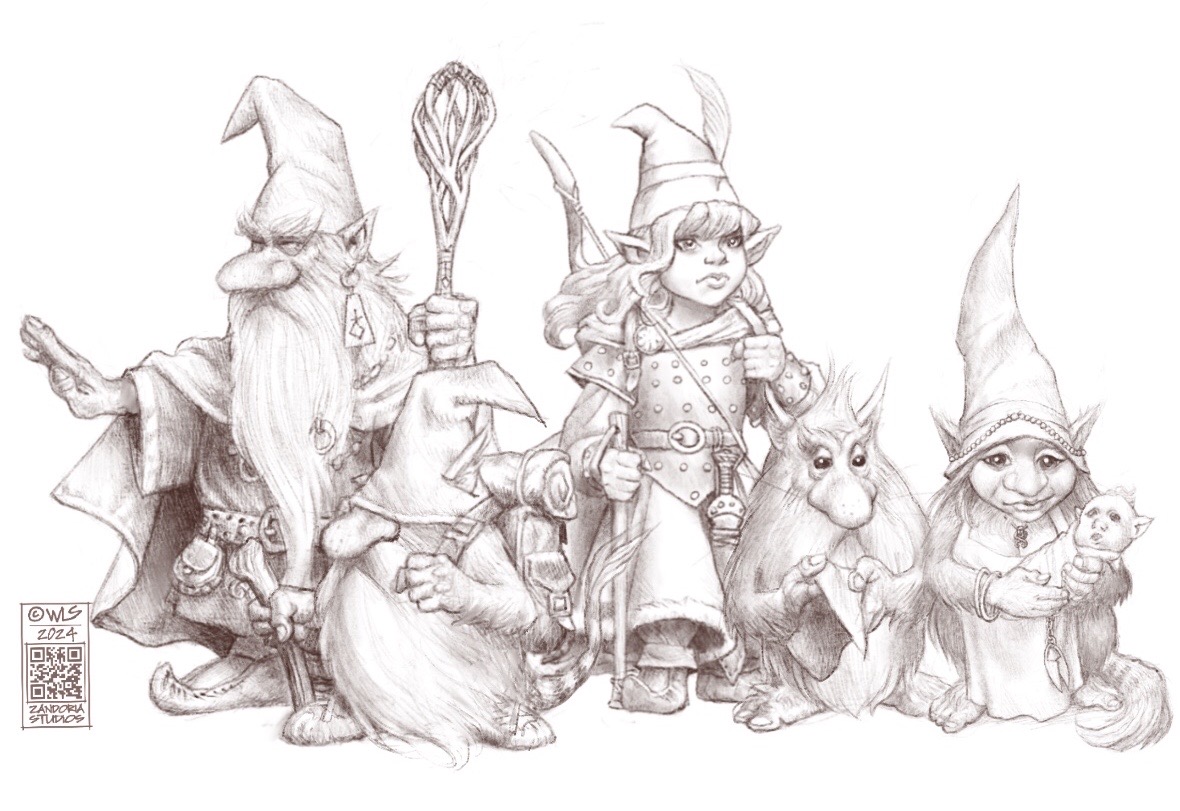
A Gnome is a mythological creature: A small, ageless dwarf in European folklore who lives underground and guards treasure. The 16th-century Swiss alchemist Paracelsus popularized the term, describing gnomes as able to move through solid earth like fish in water. They are known as Nisse or Tomte in Scandinavian folklore, where their long beards and pointed caps originates. They were also guardians of the home and farm, and popularized as Garden Gnomes in the 18th century. The modern style of “Gonk” Gnome, used as a home decoration, is essentially all beard with only a nose and large cap–They may get their name from a novelty toy from the 1960’s called a Gonk.
As Fantasy characters in Dungeons & Dragons and other TTRPGs, Gnomes are very popular. They are of small size, generally around 2′ tall. They are surprisingly strong for their size, at least as strong as a full-grown man! Because of their connection to nature, gnomes are often Druids or Rangers, but may be any Class.
A Gonk is a subspecies of Gnome. They are a little shorter in proportion, and covered in fur. Gonks are are a more feral wild version of their taller kin, and live underground in burrows. They have a natural ability to shape-shift, which leads to some remnant animal traits in their appearance. Some Gonks even have tails!
Gnomes wear tall cone-shaped felt caps, and take great pride in them. You can tell a lot about a gnome and his social status by the height of his cap. Caps are often embroidered and ornamented as well. Gnome warriors wear tall pointed helmets, which can also act as dangerous spikes to deter the big stompy feet of Trolls. Gonks also wear caps, and usually wear them pulled down to their nose to protect their sensitive eyes.
Large RPG Cities, just like Rome or Paris, have sewer systems for the primary purpose of drainage–to keep their streets from flooding. The sewers channel storm water away from the city.
Whether your RPG campaign is set in Balder’s Gate, Calimport or Waterdeep in the Forgotten Realms; Beneath the sprawling streets of Ravnica, or in the underground canals of Sigil in the outer planes, your adventures are likely to take you into the Sewers and Undercity….
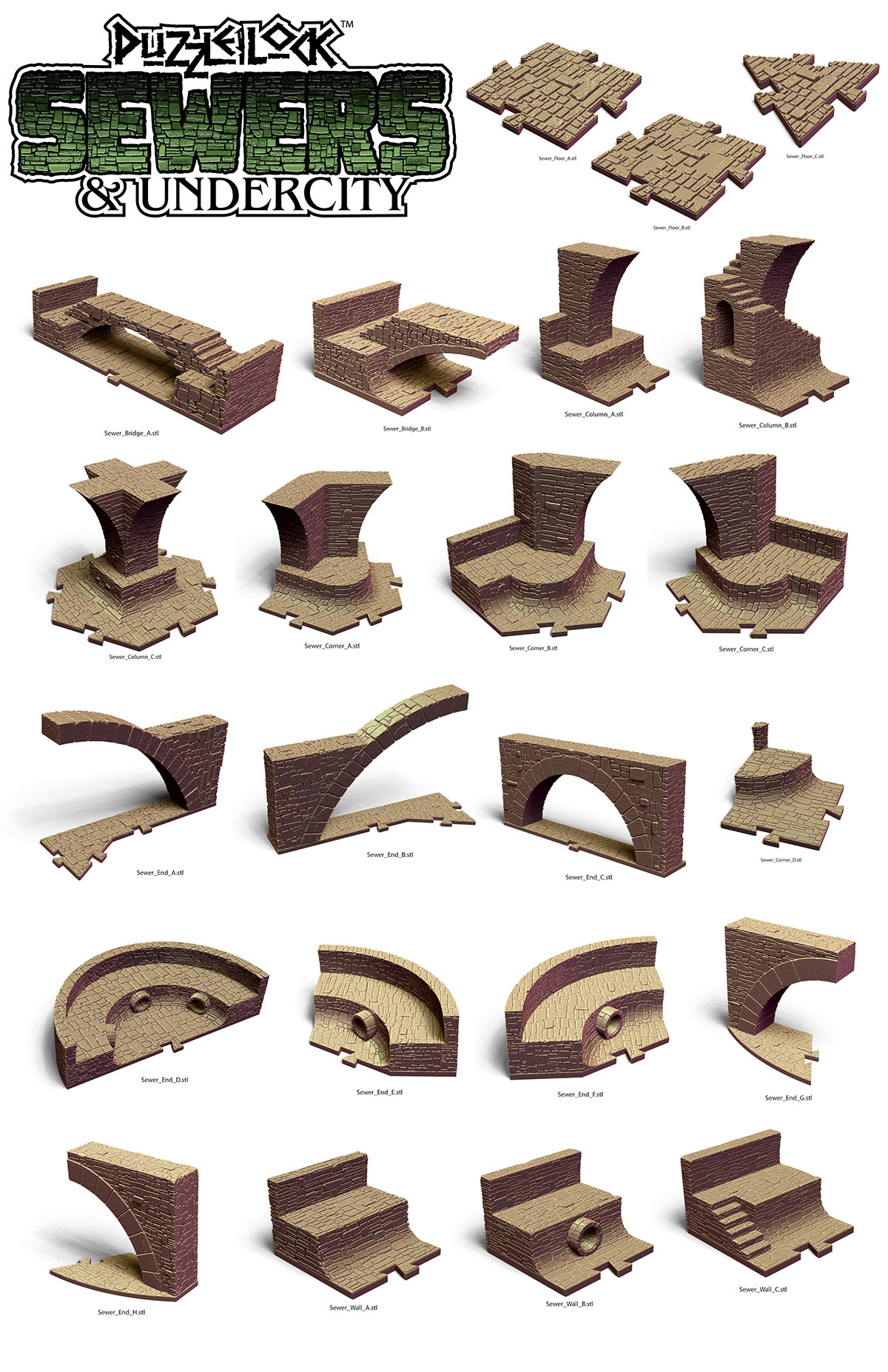
PuzzleLock Sewers and Undercity is a 3d printable terrain for 28mm tabletop RPGs. The tiles connect like a jigsaw puzzle–there is no need for clips or magnets, and the tiles require no supports for printing.
There are 23 .stl files in the set, each one exquisitely detailed to create an immersive environment. The modular design will allow you to create an endless labrinth of Sewers and Undercity.












 Zandoria Studios