DND with Minis vs. Theater-of-the-Mind

Playing D&D is great fun, and I have been adventuring with my friends for many years. We have always played the game around the table with just our character sheet, notes and dice. The DM might have a hand drawn map, but for the most part all encounters are just described in what is called the Theater-of-the-Mind style of play.

TotM can lead to confusion. “Wait, how many goblins are left?”, or “I said I was hiding behind the pillar!”, or the classic: “I didn’t ask you how big the room is–I cast Fireball!” Many of the rules in D&D are very tactical in nature. Players are aware how many feet they can move per turn, their weapon ranges, what the bonuses are for 1/2 or 3/4 cover, and are constantly peppering the DM with questions to clarify the described situation. Miniatures solve many of these issues.

With terrain and miniatures, it is very easy to see who is in the area of effect when the Fireball spell goes off. Miniatures provide clarity vs. chaos, save time and avoid unnecessary arguments.

Theater-of-the-mind may be great for most D&D encounters, and some players think that playing with minis will make the game feel too much like a boardgame. This is a valid. If the Dungeon Master gives a great description of the boss encounter, it can really come to life in the players imagination. However, what gets imagined is going to be slightly different for each player….

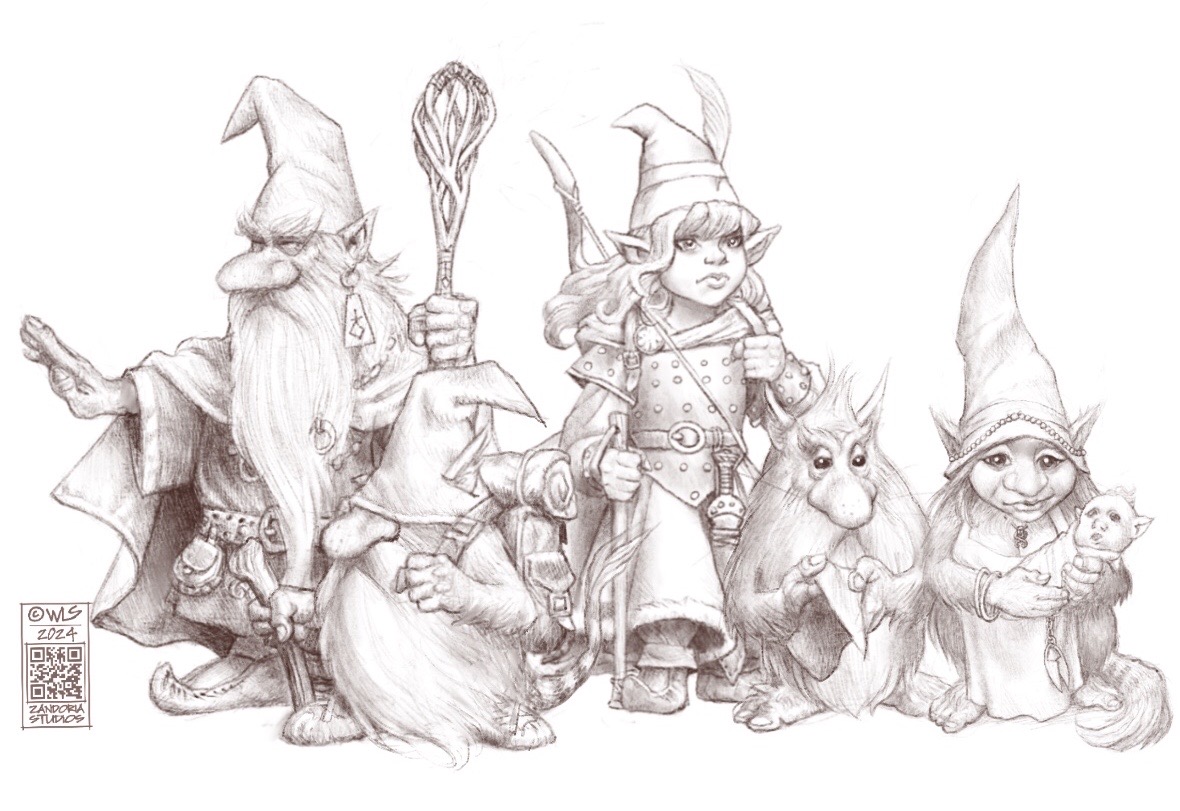
This party of gnome adventures is exploring the room, when behind them they hear the scrape of stone on stone…

The Dungeon Master says, “You turn and see a large mountain troll, with a stone axe”. As a player you may wonder what a mountain troll looks like, or how big it is relative to you; whether you should start running or draw your sword.

The DM says, “roll initiative” ominously, as he places the mountain troll mini onto the table. The players eyes go wide. They see it’s size. The immediate, visceral understanding of the threat is an “oh $#!%” moment.

Don’t just describe the threat. Make them feel it…

The moment you place that troll on the table, the game’s tension skyrockets. It is no longer an abstract concept; it’s a physical problem they need to solve. Miniatures are not mere game pieces, but are tools for creating sharper, more dramatic, and more memorable stories at your table.

These are all miniatures and terrain that I have sculpted, and are available in my shop
Gnomes and Gonks as D&D Characters

A Gnome is a mythological creature: A small, ageless dwarf in European folklore who lives underground and guards treasure. The 16th-century Swiss alchemist Paracelsus popularized the term, describing gnomes as able to move through solid earth like fish in water. They are known as Nisse or Tomte in Scandinavian folklore, where their long beards and pointed caps originates. They were also guardians of the home and farm, and popularized as Garden Gnomes in the 18th century. The modern style of “Gonk” Gnome, used as a home decoration, is essentially all beard with only a nose and large cap–They may get their name from a novelty toy from the 1960’s called a Gonk.

As Fantasy characters in Dungeons & Dragons and other TTRPGs, Gnomes are very popular. They are of small size, generally around 2′ tall. They are surprisingly strong for their size, at least as strong as a full-grown man! Because of their connection to nature, gnomes are often Druids or Rangers, but may be any Class.

A Gonk is a subspecies of Gnome. They are a little shorter in proportion, and covered in fur. Gonks are are a more feral wild version of their taller kin, and live underground in burrows. They have a natural ability to shape-shift, which leads to some remnant animal traits in their appearance. Some Gonks even have tails!

Gnomes wear tall cone-shaped felt caps, and take great pride in them. You can tell a lot about a gnome and his social status by the height of his cap. Caps are often embroidered and ornamented as well. Gnome warriors wear tall pointed helmets, which can also act as dangerous spikes to deter the big stompy feet of Trolls. Gonks also wear caps, and usually wear them pulled down to their nose to protect their sensitive eyes.

Stylizing the look…

Have you noticed that the “look” of big budget animated movies has become  homogenized?  However beautiful those globally illuminated, sub-surface scattered, realistically simulated CG worlds have become, there is a common look to them…. I think it is because the artists and the tools are the same from studio to studio…

From what I understand about the industry, artists move from film to film, studio to studio, as each project ends (self described “pixel gypsies”)… The tools are similar between studios, the feature orgy in 3D software pushing in a Darwinian way towards a synthetic hyper realism.

Style4

The last animation that I posted suffered from this same look, and I had to stop and think about why…. I think  there is an unconscious bias towards that style, because our tools favor it, and there is an expectation that for it to be accepted   it has to have that look.

I am just one guy.  Even if I thought that this homogenous CG look was great–there are hundreds of people involved in creating it–and if my work attempts to emulated it, then it will rightly be compared to it.  The animation, the particles and effects, the lighting–everything has to be at Hollywood level…If it is not, then rather than being immersed in the story with the characters, the viewer is going to be distracted….

Realizing I needed to stylize the look–Dig a little deeper than what the tools want to give me–make them give me what I want,  I started looking at my influences for TAR of Zandoria to see what it was that I liked (and figure out how to make the computer render it).

Style1

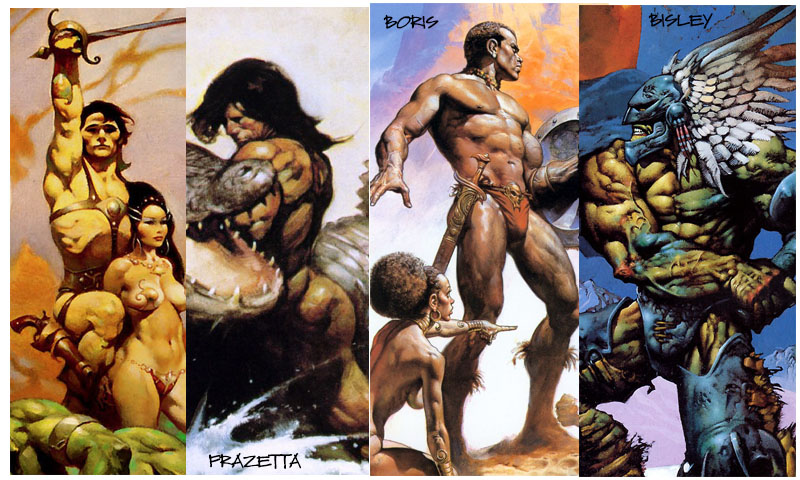
Frank Frazetta, Boris Vallejo, and Simon Bisley are my favorite fantasy artists. So I started looking at their paintings for stylistic cues that I could try to emulate–since that genre is the inspiration for TAR, if I could make it come to life that would be more satisfying….

The first thing that jumped out at me is the strong contrast between light and dark–It is called chiaroscuro in painting. The defined contours in Frazetta’s and Bisley’s work also stood out–I think this comes from their background in comics before they started painting…

Style2

The backgrounds are painted of course, and since I was already using a matte painting approach to creating my backgrounds for TAR, this is an easy shift–Even running a Photoshop filter was an improvement over the realistic matte painting…

I added toon shading to the edges of my objects, and I relighted the scene with a key light and a couple of fill lights.  I think I am also going to tweak something with the diffuse falloff at the edges, to get a look for like my airbrushed version of TAR.

http://www.youtube.com/watch?v=KlPlK46gKvA